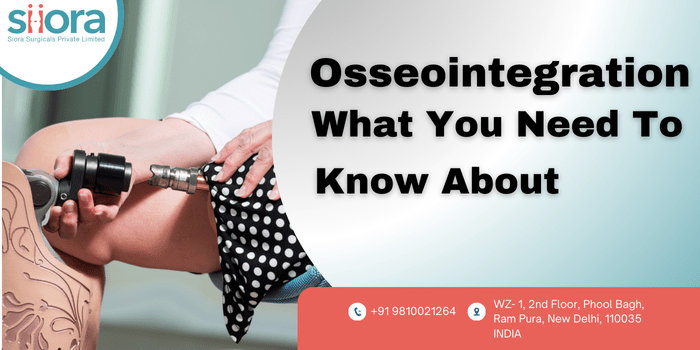
The use of metal structures like Orthopaedic Implants to fix fractured bones is not a new concept, it has been practiced for decades. One thing that has changed is the quality of implants and the effectiveness of the procedure. The field of orthopedics has evolved a lot in the last 3-4 decades and we can now have an artificial limb fitted in the amputees, and they can enjoy almost normal lives as a person with natural limbs.
The process of fitting a prosthetic limb is known as osseointegration, and this will be our topic of discussion here. So, let us see it in detail.
What is Osseointegration?
Osseointegration is a method of fixing a prosthetic limb to an amputee’s body, and the man who made it possible was Professor Per-Ingvar Branemark of Sweden. In the initial stages of his experiment, the professor tried to place implants in rabbits followed by dogs in later stages. There, he found that the implants could not be removed without breaking the bone. The first patient operated on by Professor Per-Ingvar Branemark was in 1965 where he used oral implants.
Branemark coined the term osseointegration in the year 1976 for the anchorage of implants into the original bone and it was first used in the year 1977.
Now, Osseointegration is described as the direct connection between an artificial implant and the bone in our body. Here, a metal anchor is fixed directly into the bone of the amputated limb.
Why Osseointegration is Required?
Osseointegration seems to be the best way for amputees to return to their normal lives without any difficulties. Osseointegration offers some great advantages when compared to socket prosthesis. Once the person starts to feel comfortable with the prosthetic limb fixed using osseointegration, he/she will not find it as an artificial one. Above all, it is known to ensure better functioning like walking and joint movement than the socket prosthesis.
Osseointegrated prostheses are safer as well because it does not show any skin breakdown. This type of prosthesis is fixed directly into the bone, and it improves the quality of the amputee’s life.
What Are the Advantages of Osseointegration?
The person with an osseointegrated prosthesis can effectively use it for longer periods without any difficulty. This might not be the case with socket prostheses. This type of prosthesis is also known to ensure better sitting comfort.
Studies have found that these types of prostheses do not show any skin problems plus, they are stable and ensure safe walking and standing. Besides this, one can also quickly remove and fix the prosthesis when required.
What Are the Disadvantages of Osseointegration?
Although osseointegration is a safe procedure and the inflammation of the bone due to this is rare, some people may experience intense muscle pain during the first year after the implantation. One thing you need to care about after getting an osseointegrated prosthesis is that the area where it penetrates the skin must be cleaned with soap and water twice a day.
To get international standard quality orthopedic devices like Microlock, External Fixator System, Interlocking Nails, or PFNA Intramedullary Interlocking Nail, contact a CE-certified manufacturer and exporter of orthopedic devices, Siora Surgicals Pvt. Ltd.
 Site Title
Leave a comment