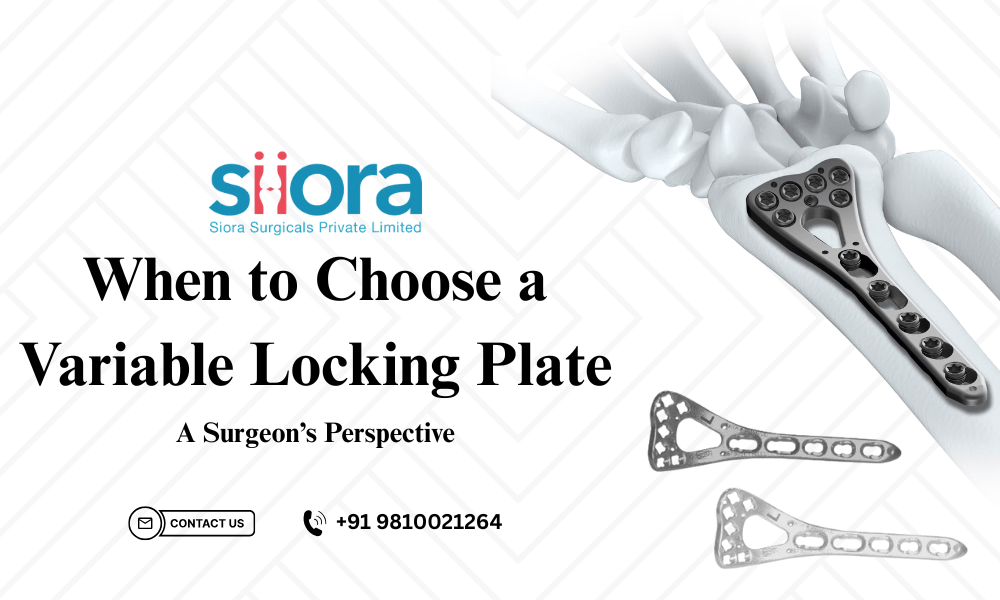
In orthopedics, every fracture is a story of trauma, anatomy, and the complex decisions surgeons make to restore function. Among the growing toolbox of fixation devices, the variable locking plate has carved out a key role. But like any tool, it’s not a one-size-fits-all solution. Choosing it depends on understanding its strengths, limitations, and where it fits best in real-world cases.
As a surgeon, you’re not just fixing bones, you’re problem-solving under pressure. And one of the most common questions in the OR is, “Should I go with a fixed-angle construct or reach for a variable angle plate?” Here’s how I approach that choice.
The Basics: What Is a Variable Locking Plate?
Unlike traditional fixed-angle plates, variable locking plates allow the screws to be inserted at a range of angles—often within a 15° cone. This gives the surgeon more control over screw trajectory while still locking into the plate to create a stable construct. That flexibility can be game-changing in certain scenarios.
When Variable Angle Wins?
Dealing with Complex Anatomy
In periarticular fractures—like distal radius, proximal tibia, or distal humerus—you’re often working around dense, irregular bone. Standard screw trajectories may not line up with safe bone corridors or might threaten nearby joints. With a variable angle plate, I can redirect the screw path without sacrificing the strength of the locked construct. That’s a major win, especially in small fragments or areas with limited bone stock.
Salvage After Failed Fixation
Revisions are tricky. Bone may already be compromised or drilled through. Fixed-angle systems often don’t offer enough flexibility to avoid previous screw paths. Variable locking systems give me the freedom to find fresh bone, angle around voids, and create a new stable construct in terrain that’s been altered.
Intra-Articular Fractures
Getting precise reduction of articular fragments is everything in these cases. The variable angle option allows me to “steer” screws into tiny pieces that a fixed-angle plate would miss. It’s especially helpful in fractures where buttressing small fragments at a very specific angle is needed.
Osteoporotic Bone
Locking constructs are already the go-to in osteoporotic patients because they don’t rely on screw purchase in the bone alone. Variable plates add to that advantage by allowing optimized screw paths in poor-quality bone—targeting the best available purchase without compromising the integrity of the plate-bone interface.
When to Hold Back?
That said, variable isn’t always better.
Simplicity and Cost
If you’re dealing with a simple diaphyseal fracture in good bone, a fixed-angle plate or even a non-locking construct may be more than enough. Variable locking plates tend to be more expensive, and overengineering adds unnecessary complexity.
Less Forgiving in Inexperienced Hands
With variable angles, there’s more room for user error. A poorly directed screw can end up in the joint, or worse, miss the fragment altogether. Precise imaging and intra-op verification are critical. For junior surgeons or low-resource settings, fixed-angle plates can be safer and more predictable.
The Surgical Mindset
In the OR, you’re always balancing competing goals, stability, biology, time, and cost. For me, the decision to use a variable locking plate is guided by a few questions:
- Will this give me better control over screw placement?
- Am I working with fragile or fragmented bone?
- Is this a revision case where standard trajectories won’t cut it?
If the answer is yes to any of those, the variable locking plate earns its place on the table.
In the end, it’s not about the trauma implant hardware, it’s about using the right tool for the right fracture, at the right time. Variable angle locking plates don’t replace sound surgical principles; they enhance them when used wisely.

